Proof of mailing: the USPS options and what each one proves
Proof of mailing from USPS: a Certificate of Mailing, a Certified or Registered Mail receipt, or a counter postmark. Current fees and what each one does not prove.
 By TUGBERK C OZEN · Updated
Proof of mailing is a dated record that the Postal Service accepted your letter. It answers one question: was this sent, and on what day? It does not answer whether it arrived. USPS has no single product by that name. It has four things that do the job, and they differ in price, in what they record and in who keeps the record.
The rules on this page come from USPS: sections 503 and 608.11 of the Domestic Mail Manual, the USPS help article Certificate of Mailing: The Basics, the USPS statement Postmarking Myths and Facts of 2 Jan 2026 and Notice 123 for prices. We read them on 13 Nov 2026. Certisent is not affiliated with USPS.
The short version
USPS itself lists the options. In its January 2026 statement on postmarks it says: "Customers who wish to retain a record or proof of the date on which the Postal Service first accepted possession of their mailpiece(s) may purchase a Certificate of Mailing. Registered Mail and Certified Mail services also provide mailing receipts for individual mailpieces." A fourth route, a postmark applied at the counter, puts the date on the envelope itself.
| What you keep | What it shows | Delivery record | USPS fee, on top of postage | |
|---|---|---|---|---|
| Certificate of Mailing (PS Form 3817) | The certificate, round-dated by the clerk | Sender, addressee and the date the piece was presented | No | $2.45 |
| Certified Mail (PS Form 3800) | A numbered receipt, round-dated if you present it to a clerk | The number, the addressee and the acceptance date | Yes | $5.55 |
| Registered Mail | A registration receipt | The registration and its date | Yes | From $20.90 |
| Manual (local) postmark at the counter | Nothing. The postmark is on the envelope | The retail unit and the date the piece was accepted | No | No fee |
Prices are from Notice 123, price list effective 4 Oct 2026.
Certificate of Mailing: the receipt USPS designed for this
The mailing standards say Certificates of Mailing "provide evidence that individual mailpieces have been presented to the USPS for mailing." The USPS help article puts it more simply: it "provides evidence that you sent an item when you say you did."
How it works, from the standards:
- You fill it in. The form "must be completed by the mailer and all entries must be typed or printed in ink." It "must show the names and addresses of the sender and addressee(s) and may show the amount of postage paid."
- You present it with the mail. Certificates "may be presented only at the time of mailing."
- The clerk dates it. Each form "is postmarked (round-dated) at the time of mailing; the form(s) are then returned to the mailer and become the mailer's receipt."
- One or two pieces use PS Form 3817. Three or more go on the firm sheet, PS Form 3665, at $0.75 per piece listed.
- A rural carrier can do it. For PS Form 3817 the standards let you give the mail and the fee to the rural carrier, who gets the certificate postmarked at the Post Office on the day of mailing and brings it back "on the next trip."
And its limits, also from USPS:
- No delivery record. "Certificates of Mailing do not provide a record of delivery." The help article adds: "No signature or receipt is obtained when Certificate of Mailing items are delivered to the recipient."
- No copy at USPS. "The Postal Service does not retain copies of either form." If you lose the certificate, there is nothing to ask for.
- No insurance, no tracking. It is a receipt, not a service that follows the letter.
It can be bought with First-Class Mail and Priority Mail, among other classes.
Certified Mail: a mailing receipt plus a delivery record
Certified Mail "provides the sender with a mailing receipt and, upon request, electronic verification that an article was delivered or that a delivery attempt was made." So it covers both ends: the receipt for the day it went, and the delivery status for the day it arrived.
The detail that matters for proof of mailing is who dated the receipt. The standards describe two cases:
- Presented to a clerk: "attach the Form 3800 with the completed receipt to the address side of the article and present the article to the USPS employee, who then round-dates the receipt (and receipts the time, if requested) to show when the article was accepted."
- Dropped in a mailbox: "attach the 'Certified Mail' sticker to the address side of the article, detach the receipt, mark the receipt to show the date, and mail the article." That date is one you wrote yourself.
The steps and the forms are in our guide to sending certified mail. If you also want the signature sent back to you, that is a return receipt.
Registered Mail: the most documented, and the most expensive
USPS calls Registered Mail "the most secure service that the USPS offers. It incorporates a system of receipts to monitor the movement of the mail from the point of acceptance to delivery." Like Certified Mail it gives the sender a mailing receipt. The fee starts at $20.90 for an article declared to have no value and rises with the declared value. It is built around security for valuable items, and the two options above cost less.
A postmark at the counter: dated, but it leaves with the envelope
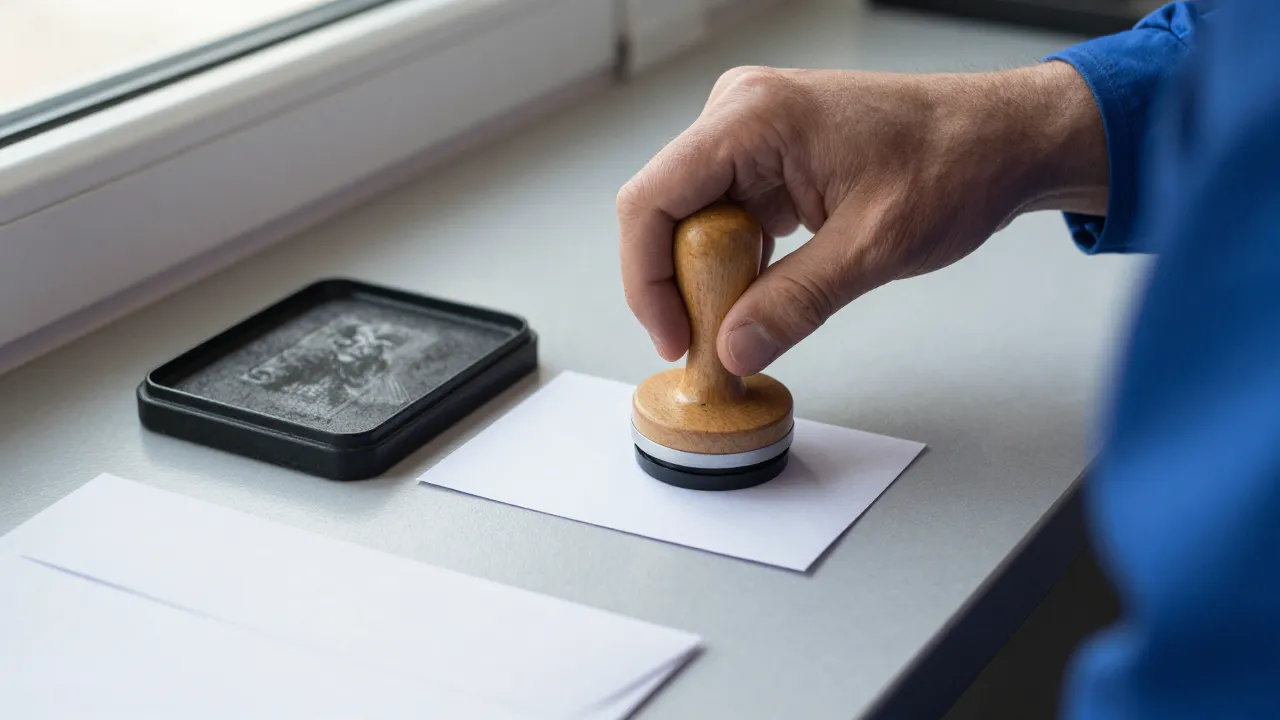
Since 24 Dec 2025 the mailing standards have a section that defines postmarks (DMM 608.11). It says a customer "may request, for no additional fee, a manual (local) postmark at any Post Office, station, or branch when tendering their mailpiece," and that because this postmark "is applied upon acceptance at the retail counter, the date on that postmark aligns with the date on which the Postal Service first accepted possession of the mailpiece."
The same section says the label a clerk prints when you pay for postage at the counter, the Postage Validation Imprint, carries the acceptance date too.
Two things to weigh:
- The postmark is on the envelope. The envelope goes to the recipient. You do not keep it, so it helps only where the recipient is the one who checks the date, for example an office that counts the postmark.
- A postmark applied by a machine is a different thing. Its date is "the date of the first automated-processing operation performed on that mailpiece," which USPS says "may be later than the date that the mailpiece was first accepted." Our page on the postmark rule goes through that.
What does not count as proof of mailing
The same DMM section is blunt about three things people rely on.
Postage you printed yourself. "Pre-printed labels applied by the customer prior to mailing (e.g., postage printed from Self-Service Kiosks (SSK), Click-N-Ship online postage, and meter strips) show merely that a customer has purchased postage and the date on which the postage was printed; they do not in themselves demonstrate that the Postal Service accepted the mailpiece, or the date on which any such acceptance occurred."
Scan data and barcodes. Markings and scans made during processing "indicate possession of a mailpiece; however, they do not constitute evidence of the date when the Postal Service first accepted possession of a mailpiece."
The absence of a postmark. It proves nothing either way: "the absence of a postmark does not imply that the Postal Service did not accept custody of a mailpiece, because the Postal Service does not postmark all mail in the ordinary course of operations."
A photo of the envelope at the mailbox, or your own note of the date, is your word. It is not a record made by USPS.
Proof of mailing is not proof of delivery
| Proof of mailing | Proof of delivery | |
|---|---|---|
| The question it answers | Did you send it, and when? | Did it arrive, when, and who took it? |
| USPS records | Certificate of Mailing; Certified or Registered Mail receipt | Delivery status of Certified or Registered Mail; return receipt with the signature |
| Who keeps it | You. USPS keeps no copy of a Certificate of Mailing | USPS keeps the delivery record of Certified Mail |
Which one you need depends on the rule you are working under. Some rules count the day you mailed. Others count the day the other side received. Read the rule, or ask the office that will apply it.
One rule that names its proof: federal tax filings
Most rules leave the kind of proof open. The IRS regulation on timely mailing does not, and it is a useful example of why the type of receipt matters.
26 CFR 301.7502-1 says that if a document is sent by U.S. certified mail "and the sender's receipt is postmarked by the postal employee to whom the document or payment is presented, the date of the U.S. postmark on the receipt is treated as the postmark date of the document or payment." For registered mail, "the date of registration" is treated as the postmark date.
On proving that a document was delivered at all, the regulation says proof of proper use of registered or certified mail, or of a designated private delivery service, are with direct proof of delivery "the exclusive means to establish prima facie evidence of delivery," and adds: "No other evidence of a postmark or of mailing will be prima facie evidence of delivery or raise a presumption that the document was delivered."
The regulation names registered mail, certified mail and designated private delivery services. It does not name a Certificate of Mailing. We read the regulation on 13 Nov 2026. This is a report of its text, not tax advice.
What you get from Certisent, and what you do not
A Certified Mail letter sent through Certisent has a USPS tracking number and a USPS delivery record. We also give you an evidence pack: one PDF with a summary, a copy of the pages we printed with their fingerprint, the time and place of the first USPS scan, the tracking history and, once USPS provides it, the electronic return receipt. We email you at every step on the way. The price is $14.99 for a letter of up to the included pages. Every Certisent letter goes by Certified Mail; we do not send untracked mail.
Be clear about what that PDF is: a record you can keep and share.
- It is Certisent's record, not a USPS form. It is not a Certificate of Mailing and it is not a PS Form 3800 receipt round-dated by a postal employee.
- If your deadline turns on a clerk's postmark, go to the counter. The federal tax rule above is one such case. Mail it yourself and have the receipt postmarked.
- No date promise. We cannot promise a delivery date or a postmark date. If your letter has a deadline, send it early.
What the service gives you is a dated trail and a USPS delivery record for a letter you did not have to carry to the counter.
This page is general information about postal services. It is not legal or tax advice.
Send certified mail from your screen
We print your letter and hand it to USPS as Certified Mail. You get the tracking number and a proof of mailing.
Start your letterIndependent service. Not affiliated with USPS, the IRS or any government agency.
Questions
What is proof of mailing?
A dated record that USPS accepted your mailpiece. It shows that you sent something, to whom and on what day. It does not show that it arrived. USPS's own name for the basic version is a Certificate of Mailing.
How do I get proof of mailing from USPS?
Hand the mail to a clerk at a Post Office counter and buy a Certificate of Mailing (PS Form 3817), or send it as Certified Mail or Registered Mail and have the receipt postmarked. All of them have to be done at the time of mailing. USPS says a Certificate of Mailing may be presented only at the time of mailing.
How much does a Certificate of Mailing cost?
In USPS Notice 123 (price list effective 4 Oct 2026, read 13 Nov 2026) a Certificate of Mailing on PS Form 3817 is $2.45 per article, in addition to postage. On the firm sheet, PS Form 3665, it is $0.75 per piece listed, with a minimum of 3 pieces.
Is a tracking number proof of mailing?
Not by itself. USPS mailing standards say markings and scan data created during processing 'do not constitute evidence of the date when the Postal Service first accepted possession of a mailpiece.' A label you printed yourself shows only that postage was bought and when it was printed.
Is a postmark proof of mailing?
It shows that USPS had the piece on the date in the postmark. USPS says it does not necessarily show the first day USPS had it, because most postmarks are applied by machines at processing plants. A postmark is also on the envelope, which goes to the recipient, not to you.
Does proof of mailing prove delivery?
No. USPS says a Certificate of Mailing does not provide a record of delivery, and that no signature or receipt is obtained when the item is delivered. For a delivery record you need a service such as Certified Mail, and a return receipt if you want the signature sent to you.
Can I get a Certificate of Mailing after I have mailed the letter?
No. It is issued when the mail is presented. What you can get later is a duplicate of a certificate you already hold: USPS says you present the original postmarked certificate and an additional one, and the new one is round-dated with the current date.
Does USPS keep a copy of my Certificate of Mailing?
No. The mailing standards say the Postal Service does not retain copies of either form. USPS's help article says it is therefore critical that you keep your receipt.
Certisent is not a law firm and does not give legal advice. Templates are fill-in forms. You decide what your letter says.