How to send certified mail, step by step
How to send certified mail at a post office or online: PS Form 3800, the return receipt choice, the fees in USPS Notice 123 and what your receipt proves.
 By TUGBERK C OZEN · Updated
To send certified mail you need three things: the letter in an addressed envelope, PS Form 3800, and money for postage plus the Certified Mail fee. You can do it at a post office counter, from your own mailbox with the form and postage already on the envelope, or through an online service that prints and mails the letter for you.
The rules on this page come from USPS: section 503 of the Domestic Mail Manual, the USPS help articles Certified Mail: The Basics and Return Receipt: The Basics, and Notice 123 for prices. We read them on 13 Nov 2026. Certisent is not affiliated with USPS.
What Certified Mail gives you, and what it does not
The Domestic Mail Manual defines it in one sentence: "Certified Mail provides the sender with a mailing receipt and, upon request, electronic verification that an article was delivered or that a delivery attempt was made."
| You get | You do not get |
|---|---|
| A mailing receipt with a number (PS Form 3800) | Faster delivery. It "is dispatched and handled in transit as ordinary mail." |
| Delivery status online or by phone | Insurance. None comes with it, apart from Priority Mail's included coverage. |
| A signature at delivery, which USPS keeps on record | A copy of that signature, unless you also buy a return receipt |
| The option to add a return receipt or Restricted Delivery | International service. It is domestic only. |
It can be added to First-Class Mail and Priority Mail. Those are the two eligible classes USPS lists.
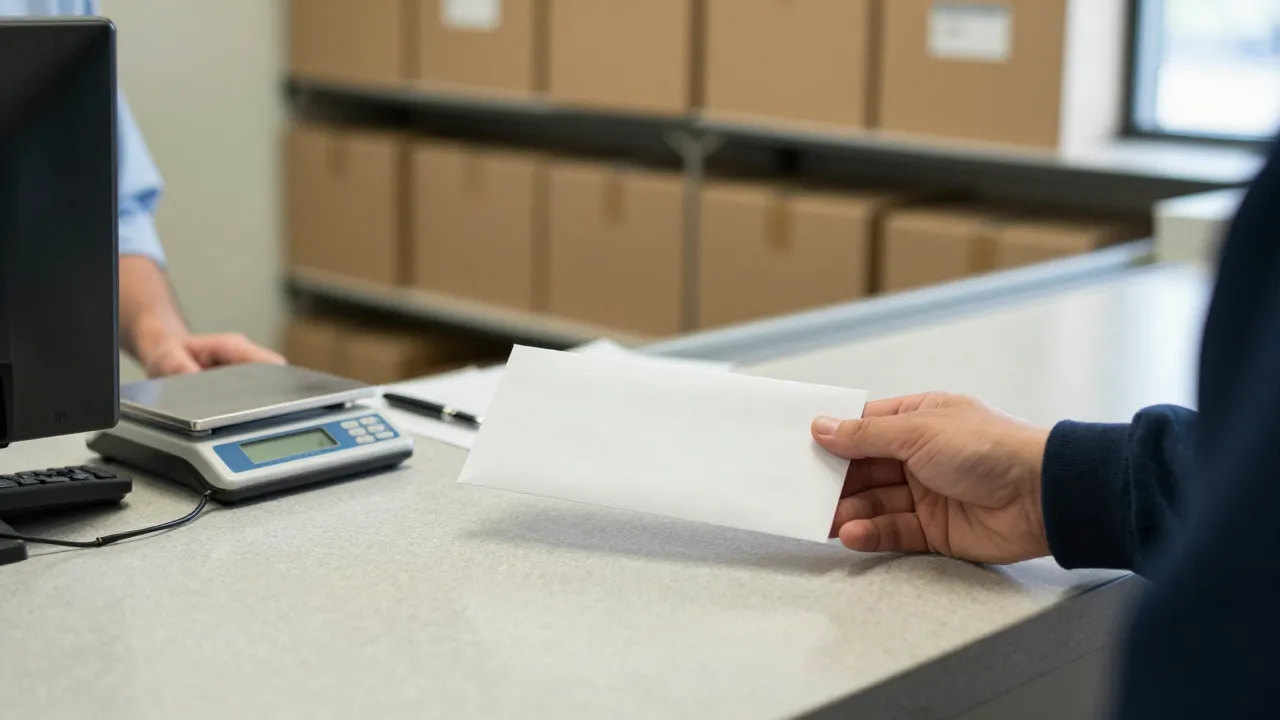
At the post office counter
The steps are in the box further down. These are the details from the mailing standards that people get wrong.
Where the label goes. The barcoded green label from PS Form 3800 goes "above the delivery address and to the right of the return address." On the form itself you enter the name and complete address of the person or firm you are mailing to.
If you want a green card. Write "Return Receipt Requested" on the address side near the Certified Mail label. Enter the Certified Mail number on the card. Put your own address on the back of the card, because that is where it will be mailed. Attach the card to the back of a small envelope, or to the front of a large one where it does not cover the address.
What you pay. Postage for the class of mail, the Certified Mail fee, and the fee for any other extra service. The return receipt card does not add to the weight: USPS excludes it when computing postage.
The postmark on your receipt. This is the step worth the trip. The standards say: "If a postmarked sender's receipt is requested, attach the Form 3800 with the completed receipt to the address side of the article and present the article to the USPS employee, who then round-dates the receipt (and receipts the time, if requested) to show when the article was accepted."
What it costs at the counter
USPS charges extra service fees "per piece in addition to correct postage." These are the retail prices in Notice 123, price list effective 4 Oct 2026:
| Item | USPS price |
|---|---|
| First-Class Mail stamped letter, 1 oz | $0.82 |
| First-Class Mail stamped letter, 2 oz | $1.11 |
| First-Class Mail stamped letter, 3 oz | $1.40 |
| Certified Mail fee | $5.55 |
| Return receipt, electronic | $2.91 |
| Return receipt by mail (PS Form 3811) | $4.65 |
| Certified Mail Restricted Delivery | $14.35 |
A certified letter is the postage line plus the Certified Mail fee, plus one return receipt line if you want one. Certified Mail Restricted Delivery is listed as a single fee that takes the place of the basic Certified Mail fee. The cost calculator adds it up for your case.
Sending it without the counter
You do not have to stand in line. The mailing standards say that, with a few exceptions that do not include Certified Mail, "items with postage and extra service fees affixed may be placed in, but not on, a Post Office maildrop, a street letterbox, or a rural mailbox, or may be given to the carrier."
The trade-off is the receipt. For that case the standards say: "attach the 'Certified Mail' sticker to the address side of the article, detach the receipt, mark the receipt to show the date, and mail the article." The date on that receipt is one you wrote, not one a postal employee stamped.
For many letters the delivery record is what counts, and that is the same either way. The receipt matters when a deadline turns on the mailing date. The IRS regulation on timely mailing, for example, gives special weight to a certified mail receipt "postmarked by the postal employee to whom the document or payment is presented" (26 CFR 301.7502-1). Our Form 941 address page goes through that rule.
Return receipt: green card or electronic
A return receipt "provides a mailer with evidence of delivery (to whom the mail was delivered and date of delivery), and information about the recipient's actual delivery address." It has to be bought at the time of mailing.
| Green card (PS Form 3811) | Electronic | |
|---|---|---|
| How it reaches you | By mail, after delivery | By email |
| USPS fee | $4.65 | $2.91 |
| On the envelope | "Return Receipt Requested" above the delivery address, card attached | No endorsement required |
| Where it is not available | APO and FPO addresses, U.S. territories and possessions, freely associated states |
Three details from the USPS help article:
- The barcode on the green card tracks the card on its way back to you. It is not the number for the letter.
- A return receipt cannot be bought after mailing. If you paid for one and it never came, PS Form 3811-A gets you the delivery record, within 90 days of the purchase, at any Post Office with your receipt.
- An electronic return receipt that has not arrived can be requested again from the tracking page, under "Return Receipt Electronic."
Restricted Delivery: when only one person should sign
Certified Mail requires a signature at delivery. Certified Mail Restricted Delivery narrows who may give it: it "permits a mailer to direct delivery only to the addressee" or the addressee's agent. The standards add a condition that catches people out: "The addressee must be an individual (natural person) specified by name." It is not a service for a letter addressed to a company or a department.
USPS also lists two adult signature versions of Certified Mail, for delivery to someone 21 or older. Its help article says they are not available at retail.
After you mail it
Tracking. Delivery information "can be retrieved at www.usps.com or by calling 1-800-222-1811," using the number on your receipt.
If nobody signs. The carrier leaves PS Form 3849. USPS's redelivery article gives the schedule for Certified Mail: a second and final notice 5 days after the first, and 15 days held in total. "Certified Mail will be held at the Post Office for 15 days and will be returned to sender on the 16th day."
The signature may not be a pen on paper that day. The standards say the signature on a proof of delivery "may be a signature that was obtained from the recipient at the time of delivery, or, for certain services, an electronic signature that was previously provided by the addressee (or representative) and is maintained on file with the Postal Service."
Refunds are narrow. The Certified Mail fee, not the postage, can be refunded when USPS is at fault for non-delivery, when you were charged incorrectly, or when a paid service was not provided. USPS says to ask 30 to 60 days after the mailing date, and that there is no refund "if the item is undeliverable, but a delivery was attempted."
Sending three or more at once
For three or more pieces with extra services presented at one time, the standards have the mailer use PS Form 3877, the firm sheet, in place of the receipt part of each individual form. If you want the sheet postmarked, you present it with the mail. If you are bringing a batch, such as notices to several tenants, ask for the firm sheet.
Sending certified mail online with Certisent
This is the route with no form, no stamps and no trip.
- Write the letter in one of our fill-in templates, or upload a PDF.
- Enter the recipient's address and your return address.
- Check the preview, which shows the exact pages and the envelope, and pay $14.99 for a letter of up to the included pages.
- We print it and hand it to USPS as Certified Mail. We email you at every step: printed, the first USPS scan, in transit, delivered. You get the tracking number, an evidence pack PDF and, after delivery, the electronic return receipt.
Three limits, so you can choose the right route:
- No hand-stamped receipt. You get USPS tracking and an electronic return receipt, not a PS Form 3800 receipt round-dated by a clerk. If your deadline depends on a postmark, use the counter.
- No date promise. We cannot promise a delivery date or a postmark date. If your letter has a deadline, send it early.
- No forms that need your ink signature. We print what you upload, so a form that has to be signed by hand, like most IRS returns, should be mailed by you. Letters are fine.
This page is general information about a postal service. It is not legal advice.
Step by step
Address the envelope with both addresses
Write the recipient's full address and your own return address. USPS requires the sender's name and complete address on the mailpiece when a return receipt is requested.
Fill in PS Form 3800
Take a Certified Mail form at the post office. Enter the name and complete address of the person or firm you are mailing to. Stick the barcoded label part above the delivery address and to the right of the return address.
Decide on a return receipt
A return receipt shows who signed and when. Choose the green card (PS Form 3811), which comes back to you by mail, or the electronic version, which comes by email. For the card, write the Certified Mail number on it and your own address on the back, and attach it to the back of a small envelope.
Hand it to the clerk and ask for a postmarked receipt
Pay the postage, the Certified Mail fee and any return receipt fee. Present the envelope with the receipt still attached and ask the clerk to postmark it. The clerk round-dates the receipt to show when the article was accepted.
Keep the receipt and follow the number
The receipt carries the Certified Mail number. Enter it at usps.com or give it by phone at 1-800-222-1811 to see the delivery or the delivery attempt. Keep the receipt with a copy of what you sent.
Send certified mail from your screen
We print your letter and hand it to USPS as Certified Mail. You get the tracking number and a proof of mailing.
Start your letterIndependent service. Not affiliated with USPS, the IRS or any government agency.
Questions
Can I send certified mail without going to the post office?
Yes. USPS mailing standards say an item with postage and extra service fees affixed may be placed in a Post Office maildrop or a street letterbox, or given to the carrier. What you do not get that way is a receipt postmarked by a postal employee: the standards say you detach the receipt, mark the date on it yourself and mail the article. An online service is the other route.
What form do I need to send certified mail?
PS Form 3800, the Certified Mail Receipt. Its barcoded green label goes on the envelope and the receipt part stays with you. If you want a mailed return receipt you also fill in PS Form 3811, the green card.
How much does it cost to send a certified letter?
At a post office you pay postage plus the Certified Mail fee, and a return receipt fee if you add one. In USPS Notice 123 (price list effective 4 Oct 2026, read 13 Nov 2026) a 1 oz stamped letter is $0.82, the Certified Mail fee is $5.55, an electronic return receipt is $2.91 and a mailed one is $4.65. With Certisent a letter is $14.99, with printing, postage and the electronic return receipt in that price.
Does certified mail arrive faster?
No. USPS says Certified Mail is dispatched and handled in transit as ordinary mail, and that it travels at the speed of the mail class it is bought with. It adds a mailing receipt and a delivery record, not speed.
What happens if nobody is home to sign?
The carrier leaves a notice, PS Form 3849. USPS says a second and final notice follows 5 days after the first, and that Certified Mail is held at the Post Office for 15 days and returned to the sender on the 16th day.
Can I add a return receipt after I have mailed the letter?
No. USPS says a return receipt can no longer be purchased after mailing. If you paid for one and it did not arrive, you can ask for the delivery record within 90 days of the purchase with PS Form 3811-A at any Post Office, showing your receipt.
Can I send certified mail to another country?
No. USPS says Certified Mail is not available with international mail. It can be sent to APO, FPO and DPO addresses and to U.S. possessions and territories, but the electronic return receipt is not available to those destinations.
Is certified mail insured?
No. USPS mailing standards say no insurance coverage is provided when purchasing Certified Mail, except for Priority Mail pieces that already include insurance. USPS also says you may not buy additional insurance as an extra service when Certified Mail is selected.
Can I get a refund of the Certified Mail fee?
In limited cases. USPS lists non-delivery when USPS is at fault, being charged incorrectly, and paid services that were not provided. A request is made 30 to 60 days after the mailing date, online or with PS Form 3533. There is no refund when delivery was attempted and the item was undeliverable.
Certisent is not a law firm and does not give legal advice. Templates are fill-in forms. You decide what your letter says.